COMMERCIAL ML · PRODUCTION DEPLOYED
Recommendations from transaction data, not clickstreams.
Physical stores do not have clickstreams or browsing histories. This statistical engine turns ordinary receipts into profitable product recommendations at the exact moment a shopper is in the store or on the web.
+5%
GROSS PROFIT LIFT
Measured against unpersonalized control groups in live store deployment.
40%
HIT RATE
Returning shoppers buying at least one recommended item during active cycles.
THE PHYSICAL RETAIL REALITY
Built for sparse receipts and flexible business goals.
Standard e-commerce recommenders assume customers generate hundreds of clicks every week. In brick-and-mortar retail, many shoppers visit only a few times a year, baskets are small, and data is sparse.
Pushing discounted bestsellers destroys margin because customers would have bought those items anyway. This engine models natural cross-sell and replenishment intervals while letting the retailer choose the objective function: you can configure it to maximize the number of sold items, total revenue, or gross margin.
Tested across four retail sectors. Proven live in production.
The engine was evaluated on real transaction histories across four different retail chains: supermarkets, drugstores, sporting goods, and toy stores. Despite vastly different shopping frequencies and catalog sizes, it delivered a consistently high hit rate across every chain, and generated a verified +5% gross profit lift in live production.
SUPERMARKETS
High-frequency grocery baskets
DRUGSTORES
Routine personal & home care
SPORTING GOODS
Seasonal equipment & gear
TOYS & SPECIALTY
Infrequent, gift-driven purchases
MATHEMATICAL ARCHITECTURE
Why neural networks fail here, and how our two-step model works.
On sparse receipt data, deep neural networks overfit noise and collapse into recommending the same ten popular items to everyone. Running on standard CPUs without GPUs, our architecture separates candidate discovery from probability scoring.
STEP 1 · CANDIDATE SELECTION
Custom similarity between customers and products
The first stage measures mathematical similarity between customers and between products across historical transactions using custom similarity metrics built for sparse baskets. This filters the catalog down to relevant candidate products for each shopper.
STEP 2 · PROBABILISTIC SCORING & STRATEGY
Time-specific interest prediction and commercial ranking
In the second stage, probabilistic classifiers predict the exact probability that a specific customer will be interested in each candidate product at that specific moment. Those probabilities are then combined with your commercial strategy (optimizing for sold items, revenue, or gross margin) to select the final recommendations.
DEPLOYMENT & DATA
Plug-and-play API. Minimal data required.
Works with any device or stack
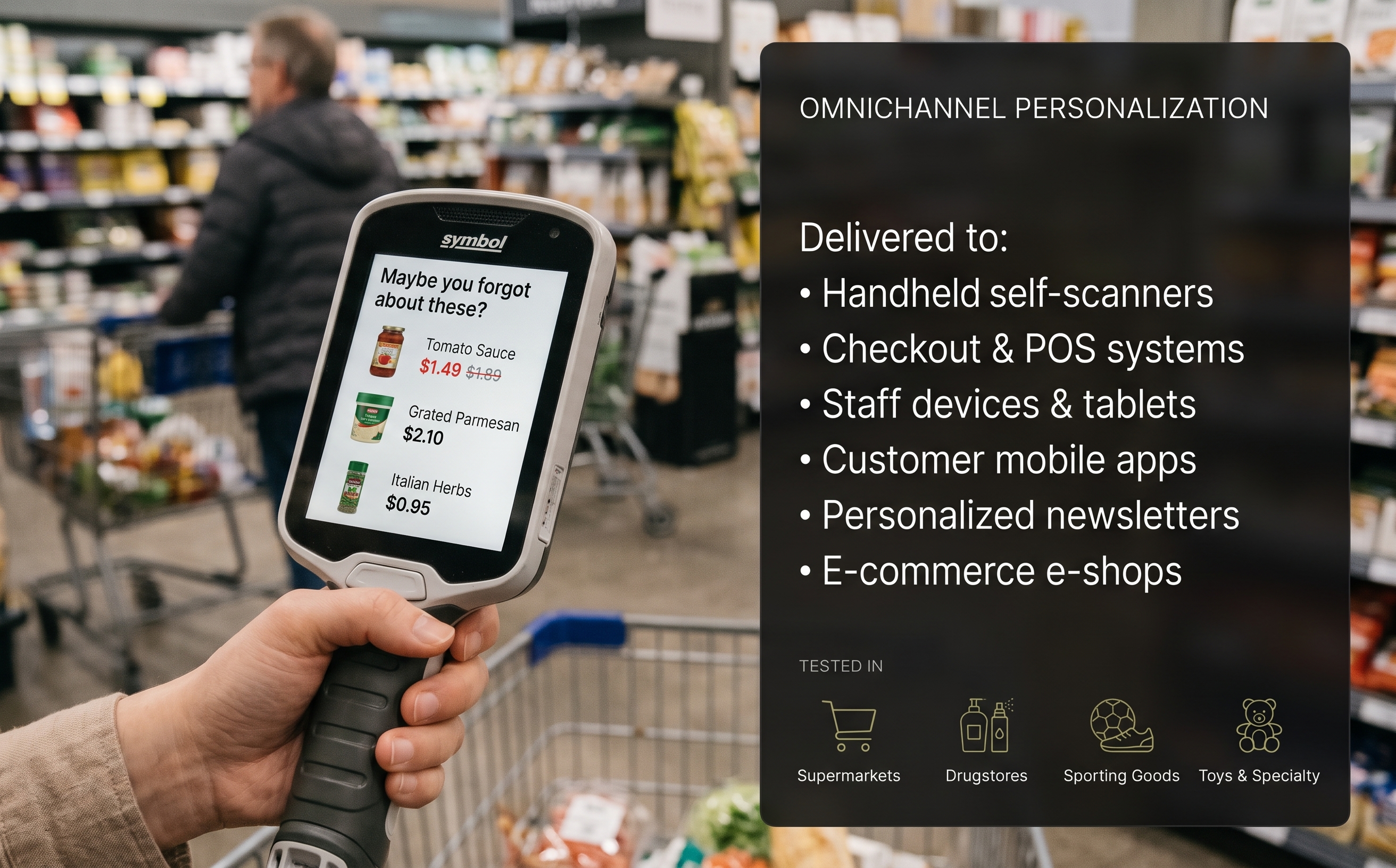
The engine runs as an independent API compatible with any programming language, POS system, handheld self-scanner, staff tablet, mobile app, newsletter tool, or e-shop. Your existing software simply sends a request and receives ranked product IDs in milliseconds.
Works even for anonymous shoppers
All we need to start are historical purchase records and a customer ID when available. If a shopper does not identify with a loyalty card or app, the engine uses the items currently in their basket to deliver targeted real-time recommendations on the spot.
EVALUATE ON YOUR OWN DATA
Want to see what your transaction history can generate?
Before touching production systems, we can run a focused 2-to-3-week offline evaluation on an anonymized sample of your past receipts. You get a clear report showing exact hit rates and expected margin lift on your own customers.
BEYOND RECOMMENDATIONS
Other retail problems we solve with transaction and operational data.
Demand & Spoilage Forecasting
Predicting store-level demand for fresh and seasonal goods to cut waste and out-of-stock losses.
Inventory & Logistics Optimization
Optimizing warehouse-to-store replenishment and stock allocation across branches.
Pricing & Promotion Analytics
Measuring true promotional lift vs. cannibalization and timing markdowns to protect margin.
Assortment & Basket Analysis
Identifying which products drive store visits and which SKUs can be delisted safely.